
Wildlife and flora
Enjoy a diverse and rich natural environment all around the unusual accommodations.
Classified site Znieff
Our Environment
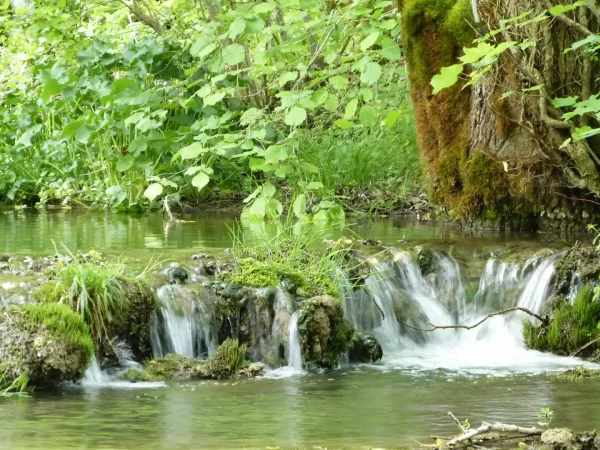
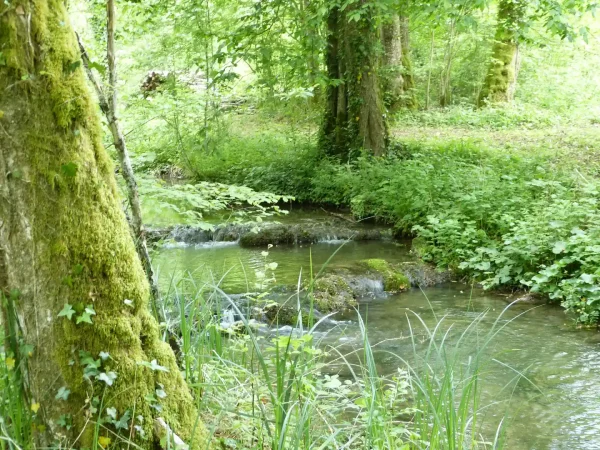
In the forest and along the Trimeule, a tufa stream* that runs through the estate, you can observe exceptional wildlife and flora. You will find many species of birds, flowers, and butterflies. Among them is the White-throated Dipper, a small, stocky brown and white bird. This waterfall-nesting bird lives near fast, rocky streams in which it literally dives to find its food. You will also spot tits, garden warblers, blackbirds, robins, wrens, and great spotted woodpeckers.
The site is also a refuge for squirrels and with a bit of patience, you may see hares and other local wildlife.
And in the waters of the Trimeule, fishing enthusiasts will find brown trout, bullheads, and perch. However, to preserve this wildlife, we encourage catch-and-release (“no kill”) fishing.
To provide more detail about the different animal and plant species that can be seen on the estate, we will soon be installing information panels.
* Tufa is a very friable calcareous rock, formed by the precipitation of limestone on existing vegetation. It can take various forms, for example the waterfall over which the Trimeule flows, visible on the estate.
What is a ZNIEFF?
and what is it for?
A ZNIEFF is a Natural Zone of Ecological, Fauna and Flora Interest (Zone Naturelle d’Intérêt Écologique Faunistique et Floristique). It designates land officially recognised for its ecological value. In addition, it also records natural habitats as well as rare or threatened species.
The ZNIEFF is a tool dedicated to nature conservation. This is why urban planning documents of the municipalities concerned must take the ZNIEFF classification into account. Ultimately, it helps alert public authorities to the quality and richness of the natural environment, as well as to the presence of protected plant and animal species.
Following the surveys carried out on the estate, 6 plant species can be considered remarkable on the scale of the former Champagne-Ardenne region. These are: Purple toothwort (Lathraea squamaria L. 1753), fumewort (Corydalis solida (L.) Clairv.), unspotted lungwort (Pulmonaria obscura Dumort. 1865), caraway (Carum carvi L., 1753), and sharp-leaved pondweed (Potamogeton acutifolius Link, 1818). We should also highlight the presence in the undergrowth of two-leaf squill (Scilla bifolia L., 1753).
Explanation
A rich environment
Twenty-five bird species have been recorded on the Domaine du Moulin de Trimeule. Based on the observations made during this study, four species can be considered probable breeding birds and two others as potential breeders.
These 25 species are: white wagtail (Motacilla alba), grey wagtail (Motacilla cinerea), Eurasian bullfinch (Pyrrhula pyrrhula), mallard (Anas platyrhynchos), white-throated dipper (Cinclus cinclus), common starling (Sturnus vulgaris), blackcap (Sylvia atricapilla), garden warbler (Sylvia borin), Eurasian jay (Garrulus glandarius), fieldfare (Turdus pilaris), song thrush (Turdus philomelos), grey heron (Ardea cinerea), common blackbird (Turdus merula), long-tailed tit (Aegithalos caudatus), blue tit (Parus caeruleus), great tit (Parus major), marsh tit (Poecile palustris), great spotted woodpecker (Dendrocopos major), black woodpecker (Dryocopus martius), common wood pigeon (Columba palumbus), chaffinch (Fringilla coelebs), willow warbler (Phylloscopus trochilus), chiffchaff (Phylloscopus collybita), goldcrest (Regulus regulus), European robin (Erithacus rubecula), and wren (Troglodytes troglodytes).
